

Calcium and boron are closely associated with the development and integrity of growing plant tissues. They are often discussed together, but their behaviour inside the plant and soil presents unique management challenges. Understanding mobility and availability is therefore as important as understanding the total quantity applied.
Why Calcium Management Can Be Difficult
Calcium contributes to cell walls, membranes and tissue strength. It moves mainly with the transpiration stream, which means distribution is influenced by water movement and transpiration. Young leaves, flowers and developing fruits may receive less calcium when humidity is high, root activity is restricted or water supply fluctuates.
A soil may contain calcium while sensitive tissues still experience inadequate delivery. This is why irrigation consistency, root health and application timing must be considered alongside the calcium source.
The Role of Boron
Boron supports cell wall formation, growing points, pollen function and reproductive development. The safe and effective range between deficiency and excess can be narrow, so boron should be applied carefully according to crop need and approved recommendations.
Formulation and Delivery Matter
For foliar and rapid-correction programmes, solubility, stability, spreadability and tissue compatibility influence performance. A formulation designed to maintain nutrients in an available form can help support more consistent delivery during critical stages.
CRACKFIX-CA uses Acetate Based Calcium Technology™. It is designed to improve calcium solubility, penetration, mobility and bioavailability, with a declared calcium content of 7%. It is positioned for calcium support and rapid correction during important growth periods.
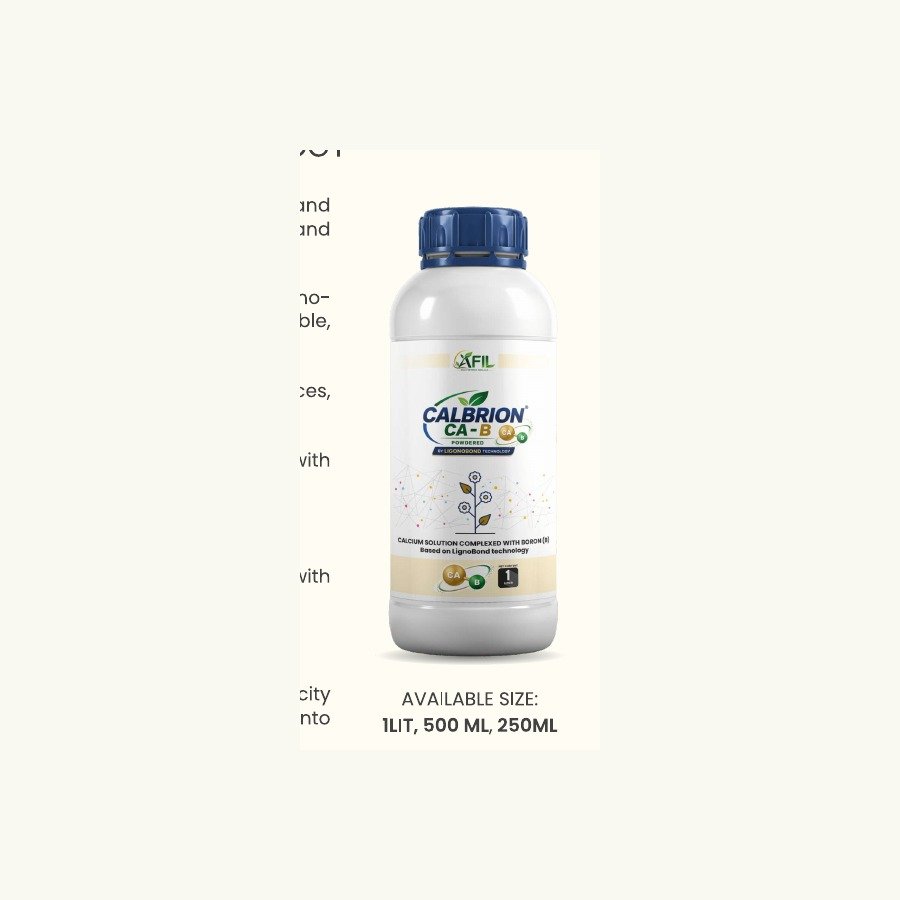
CALBRION CA-B uses LignoBond Technology™ to maintain calcium and boron in a stable, plant-compatible organic ligno-complex. The formulation is designed to support nutrient bonding, leaf penetration, controlled release and internal translocation. Its declared contents are calcium 10.7% and boron 0.95%.
Building a Practical Calcium–Boron Programme
- Maintain consistent soil moisture and avoid sudden wet–dry cycles.
- Protect root health and avoid conditions that restrict uptake.
- Apply preventively around critical development stages where agronomically appropriate.
- Use boron precisely; more is not necessarily better.
- Confirm spray water quality and tank compatibility.
- Do not rely only on foliar nutrition where a broader soil or irrigation issue exists.
Effective calcium and boron management combines the right source with correct timing, active roots and stable water relations. Formulation technology can support delivery, while sound agronomy addresses the conditions that control nutrient movement.
Explore Related Afil Solutions
Contact the Afil team for product selection and application guidance.
This article provides general educational information. Product selection, dosage and application should follow the approved label and guidance from a qualified agricultural professional.